
Tag Archives: LightWave Networks
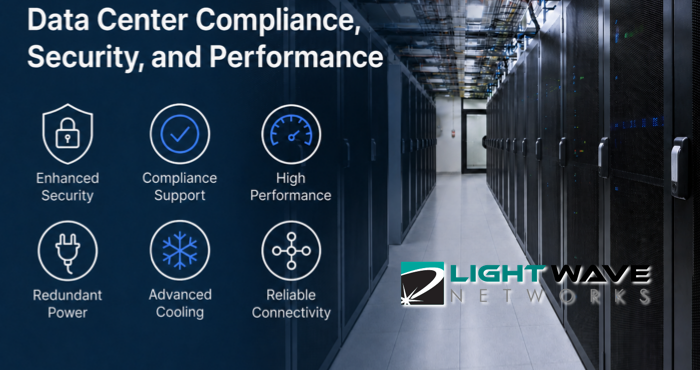
Colocation for Data Center Compliance, Security, and Performance
Organizations in regulated and data-intensive industries need infrastructure that supports security, reliability, performance, and control. As those requirements become more complex, maintaining critical equipment in an office server room or private facility may no longer be practical.
Colocation allows an organization to own and manage its servers while placing them inside a professional data center. Lightwave Networks provides the power, cooling, connectivity, physical security, and facility support needed to operate that equipment.
For some organizations, colocation supports data center compliance efforts. For others, it provides the capacity and flexibility required for specialized or high-performance workloads.
How Colocation Supports Compliance and Performance
Colocation does not make an organization compliant with a law, regulation, or industry standard. Compliance also depends on system configurations, software security, access permissions, data handling, documentation, vendor relationships, and internal procedures.
A colocation facility can support those efforts through controlled physical access, secure cabinets, monitored environments, redundant infrastructure, and documented operating practices. Organizations should confirm which standards a facility supports and how responsibilities are divided between the provider and customer.
Colocation also gives customers direct control over their hardware, storage, networking, and system architecture. This flexibility is valuable when standardized hosting or cloud plans cannot meet a workload’s configuration, latency, power, cooling, or capacity requirements.
Financial Services
Banks, payment processors, investment firms, insurance companies, and financial technology providers depend on systems that process sensitive information and support time-sensitive transactions.
Colocation for financial services firms can provide a controlled environment for transaction platforms, customer records, risk-management systems, and other critical equipment. Redundant connectivity and power infrastructure can also help organizations reduce the operational risks associated with an outage.
Financial organizations may need to address PCI DSS requirements, audit obligations, cybersecurity controls, and record-retention policies. A provider’s facility controls and documentation can support those programs while the financial institution remains responsible for its own systems, applications, and governance.
Healthcare and Health Technology
Healthcare providers, laboratories, medical software companies, and health technology platforms may process protected health information across clinical, billing, imaging, and administrative systems.
Colocation can give these organizations greater control over where their hardware is located and who can physically access it. A professionally managed facility can also offer more dependable power, cooling, and environmental monitoring than equipment housed inside a medical office or administrative building.
Healthcare organizations should confirm whether a provider can support their HIPAA-related requirements, including any necessary agreements, documentation, security measures, and operational procedures.
E-Commerce and Payment Platforms
Online retailers and payment platforms need infrastructure that can remain available during seasonal demand, promotions, product launches, and sudden traffic increases.
Colocation lets these businesses select server, storage, and network configurations based on transaction volume and application requirements. They can also design redundant systems that reduce dependence on a single server, connection, or piece of equipment.
Businesses that store, process, or transmit payment-card information must consider how their infrastructure supports PCI DSS requirements. The facility can help protect the physical environment, while the business remains responsible for areas such as application security, access controls, and payment-data handling.
Software, SaaS, and Digital Platforms
Software companies and SaaS providers need reliable infrastructure for customer applications, databases, development environments, and production workloads.
Colocation can benefit established platforms with predictable demand, specialized configurations, or hybrid infrastructure strategies. These companies can retain control of core systems while connecting colocated equipment with cloud resources, dedicated servers, or other environments.
Carrier options, network capacity, scalable cabinet space, and low-latency connectivity may be especially important for platforms serving customers across multiple markets.
Artificial Intelligence and High-Performance Computing
AI training, analytics, engineering simulations, scientific computing, and other high-performance workloads can require dense deployments of GPUs and specialized servers.
These systems often use more power and generate more heat than conventional business equipment. Colocation for high-performance computing therefore requires careful planning around power density, cooling, network capacity, hardware dimensions, and future expansion.
GPU colocation and AI server colocation also allow organizations to select and own the equipment used for their workloads. This can provide more control over hardware availability, data placement, workload scheduling, and long-term infrastructure costs than relying entirely on rented cloud capacity.
Manufacturing, Engineering, and Industrial Technology
Manufacturers and engineering organizations increasingly depend on automation systems, connected equipment, design applications, digital twins, analytics, and operational data.
Some of these systems need consistent processing and dependable connectivity between production facilities, remote users, and centralized infrastructure. Colocation can provide a stable location for proprietary servers, storage systems, and network equipment without requiring the organization to build its own data center.
It can also support equipment or configurations that do not fit neatly within standard cloud or hosting services.
Legal and Professional Services
Law firms, accounting practices, consulting companies, and other professional-services organizations manage confidential client records, financial information, intellectual property, and litigation materials.
These businesses may choose colocation when they want to retain control over critical systems while improving physical security and infrastructure reliability. Moving equipment out of a typical office can reduce exposure to inadequate cooling, localized power failures, theft, and accidental damage.
The organization should still evaluate whether it has the technical resources needed to manage its hardware or whether it needs additional monitoring, maintenance, or remote support.
Choosing Colocation for Your Industry
The right colocation environment depends on the workload, compliance obligations, technical capabilities, and growth plans of the organization using it.
Before selecting a provider, evaluate its physical controls, power and cooling capacity, connectivity, redundancy, certifications, support options, and ability to accommodate future equipment. Organizations with regulated data or specialized hardware should also document which responsibilities belong to the facility provider and which remain with their internal teams.
Lightwave Networks works with organizations across regulated and data-intensive industries. If your organization is planning for stricter compliance requirements, higher-performance workloads, or long-term infrastructure growth, a consultative infrastructure assessment can help identify the right colocation environment.
We provide colocation services for organizations that need secure facilities, customizable infrastructure, and support for regulated or high-performance environments. Connect with one of our engineers to discuss your data center compliance responsibilities, workload requirements, and infrastructure goals.

An On-Premise Data Center vs. a Colocation Data Center
Cost, Control and Security
At Lightwave Networks, organizations evaluating infrastructure strategy are often deciding between maintaining an on-premise data center and moving into a colocation data center that is designed for resilient power, cooling, connectivity, and physical security. This is not a theoretical comparison. It is a practical decision that directly impacts cost structure, operational responsibility, security posture, and long-term scalability.
For teams at the decision stage, the question is not which model is universally better. The question is which model aligns with how their business plans to operate, scale, and manage infrastructure over time. In many cases, the decision comes down to whether maintaining a private facility still makes sense or whether a colocation data center offers a more efficient path forward.
Understanding the Core Difference
At a high level, both models support the same outcome. Applications run, data is stored, and systems remain available. The difference lies in who owns and operates the environment that makes that possible.
An on-premise data center places full responsibility on the organization. That includes the facility, power delivery, cooling systems, physical security, and infrastructure maintenance.
Colocation separates those responsibilities. The organization owns and manages its hardware, while the facility provides the environment. That includes power, cooling, physical security, connectivity, and redundancy.
This distinction becomes more important as infrastructure requirements increase.
Cost: Capital Investment vs. Operational Efficiency
The cost of housing data is often the first driver behind this decision, but it is also the most misunderstood.
On-premise environments require significant upfront investment. Building or upgrading a facility involves real estate, power infrastructure, cooling systems, and physical security controls. These are long-term capital expenses that must be planned years in advance. Once deployed, ongoing costs include maintenance, staffing, energy consumption, and periodic upgrades.
Colocation shifts much of that burden into a more predictable operating expense model. Instead of building a facility, organizations lease space, power, and connectivity within an existing environment designed for high-density infrastructure.
The key difference is not simply capex versus opex. It is how efficiently resources are used over time.
On-premise environments often struggle with overprovisioning. Capacity must be built ahead of demand, which can lead to unused space, excess power allocation, and stranded infrastructure. Colocation environments are designed to scale incrementally, which allows organizations to align costs more closely with actual usage.
For organizations planning long-term growth or facing fluctuating demand, that flexibility can reduce both waste and risk.
Control: Ownership vs. Operational Responsibility
Control is one of the most common reasons organizations hesitate to move away from on-premise infrastructure.
With an on-premise data center, control is absolute. The organization determines how systems are configured, how access is managed, and how infrastructure evolves. There is no reliance on external providers for facility-level operations.
However, that level of control comes with full operational responsibility. Every aspect of uptime, redundancy, and performance must be designed, implemented, and maintained internally.
Colocation maintains control where it matters most, at the hardware and system level. Organizations retain ownership of their servers, networking equipment, and configurations. They decide how workloads are deployed and managed.
The difference is that facility-level responsibility shifts to a provider that is built to support it. Power redundancy, cooling systems, physical access controls, and network interconnects are managed within an environment designed for continuous operation.
For many organizations, the decision becomes less about giving up control and more about redefining where control is most valuable.
Security: Internal Oversight vs. Layered Infrastructure Protection
Security considerations extend beyond firewalls and access credentials. They include physical security, environmental stability, and operational resilience.
On-premise environments allow for direct oversight. Organizations can control physical access, implement internal security policies, and monitor systems within their own facilities. For some teams, this level of visibility is a key advantage.
At the same time, maintaining enterprise-grade security at the facility level requires significant investment. Access controls, surveillance systems, environmental monitoring, and redundancy measures must all be implemented and continuously maintained.
Colocation facilities are designed with layered security as a foundational requirement. This includes controlled access points, surveillance systems, and infrastructure designed to reduce the risk of environmental or operational disruption.
The tradeoff is not between secure and insecure environments. It is between managing security internally and leveraging a facility purpose-built to support it.
For organizations with strict compliance requirements or limited internal resources, that distinction can influence both risk and operational complexity.
When On-Premise Still Makes Sense
Despite the advantages of colocation, on-premise environments remain a valid choice in specific scenarios.
Organizations with highly specialized infrastructure requirements may prefer to maintain full control over their facilities. This can include custom hardware deployments, unique security constraints, or legacy systems that are difficult to relocate.
There are also cases where existing investments make continued use of an on-premise data center more practical in the short term. If a facility is already built and operating efficiently, the immediate incentive to move may be limited.
In these situations, the decision is often influenced by long-term planning rather than immediate cost savings.
When Colocation Becomes the Better Fit
Colocation becomes more compelling as infrastructure demands increase and operational complexity grows.
Organizations expanding into high-density deployments, requiring greater power availability, or needing more robust redundancy often reach a point where maintaining an on-premise facility becomes less efficient.
A colocation data center is designed to support these requirements without the need for large-scale capital investment. They also provide access to connectivity ecosystems that can be difficult to replicate internally.
For teams focused on scalability, performance consistency, and reducing facility-level risk, colocation can align more closely with long-term infrastructure strategy.
Frequently Asked Questions
Is colocation cheaper than an on-premise data center?
Colocation can reduce long-term costs by eliminating the need to build and maintain a private facility. Instead of investing in power systems, cooling infrastructure, and physical security, organizations pay for space, power, and connectivity as needed. On-premise environments may appear cost-effective if infrastructure is already in place, but they often require ongoing capital investment and maintenance that can increase total cost over time.
What is the main difference between colocation and on-premise data centers?
The primary difference is who manages the facility. In an on-premise data center, the organization is responsible for the building, power, cooling, and security. In a colocation environment, the provider manages the facility infrastructure while the organization retains control over its hardware and systems.
Does colocation provide the same level of control as on-premise infrastructure?
Colocation allows organizations to maintain control over their servers, networking equipment, and configurations. The main difference is that facility-level responsibilities, such as power delivery, cooling, and physical security, are handled by the provider rather than internal teams.
Is colocation more secure than an on-premise data center?
Both models can be secure, but they approach security differently. On-premise environments rely on internal controls and resources, while colocation facilities are designed with layered physical security, monitoring systems, and environmental protections. The level of security depends on how each environment is implemented and maintained.
When should a business move from on-premise to colocation?
Organizations often consider colocation when infrastructure demands exceed the capacity of their current facility, when power and cooling requirements increase, or when maintaining a private data center becomes less efficient. Growth, scalability needs, and risk management are common drivers behind the transition.
Making the Right Decision for Your Infrastructure Strategy
The choice between colocation and on-premise data centers is not a simple comparison. It is a decision about how infrastructure should be owned, managed, and scaled over time.
On-premise environments offer maximum control but require significant investment and ongoing operational responsibility. Colocation environments reduce facility burden while allowing organizations to maintain control over their systems within a purpose-built infrastructure.
At Lightwave Networks, colocation solutions are designed to support organizations that need reliable power, scalable capacity, and secure environments without the overhead of maintaining their own facilities.
For teams evaluating their next step, the focus should remain on alignment. The right model is the one that supports both current workloads and future growth without introducing unnecessary complexity or risk. Contact one of our engineers today to find out if colocation or on-premise solutions are right for your business, and learn about our other services and offerings, including blended GBP IP transit solutions.

Colocation vs. Cloud Hosting
Which Model Fits Your IT Strategy?
At Lightwave Networks, organizations evaluating infrastructure strategy are often deciding between cloud hosting and deploying their own hardware within a colocation data center. This comparison is not about where data lives. It is about how compute resources are delivered, controlled, and scaled.
For teams making this decision, the question is not which model is more popular. The question is whether renting compute through cloud hosting or deploying dedicated infrastructure in a colocation environment better aligns with performance requirements, cost expectations, and long-term operational strategy.
Understanding the Core Difference
Cloud hosting provides on-demand access to virtualized compute resources. Infrastructure is abstracted, and workloads run on shared environments managed by a provider. Resources can scale quickly, and organizations pay based on usage.
Colocation takes a different approach. Instead of renting compute, organizations deploy and manage their own physical hardware inside a colocation data center. The facility provides power, cooling, physical security, and connectivity, while the organization maintains full control over its systems.
This difference defines how each model behaves under real-world workloads.
Cost: Consumption Flexibility vs. Long-Term Efficiency
Cloud hosting is built for flexibility. Organizations can scale resources up or down as needed, which can be useful for variable or unpredictable workloads. The pricing model is based on consumption, which reduces the need for upfront investment.
However, long-term usage can introduce cost complexity. As workloads stabilize and scale, ongoing usage costs can increase and become less predictable, especially when factoring in data transfer, storage, and compute utilization.
Colocation shifts the cost model. Instead of paying for compute on demand, organizations invest in their own hardware and place it in a colocation data center. This requires upfront capital, but it can provide more predictable costs over time, especially for steady, high-utilization workloads.
The decision often depends on whether flexibility or long-term cost control is the priority.
Control: Abstracted Infrastructure vs. Direct Hardware Ownership
Cloud hosting abstracts infrastructure management. Providers handle the underlying hardware, networking, and facility operations. This allows teams to focus on applications and services rather than physical systems.
That abstraction comes with tradeoffs. Organizations have limited visibility into the underlying hardware and must operate within the constraints of the provider’s environment.
Colocation provides direct control over hardware. Organizations choose their servers, configure their environments, and manage their infrastructure according to their own requirements. The colocation data center supports the environment, but does not dictate how systems are deployed or configured.
For organizations with specific performance requirements, compliance needs, or custom configurations, that level of control can be critical.
Performance: Shared Resources vs. Dedicated Infrastructure
Performance characteristics differ significantly between the two models.
Cloud hosting environments rely on shared infrastructure. While providers offer high availability and scalability, performance can vary depending on resource allocation, workload distribution, and underlying architecture.
Colocation environments support dedicated infrastructure. Organizations deploy hardware that is not shared with other tenants, which allows for more consistent performance and greater control over system behavior.
For workloads that require predictable performance, such as high-throughput processing, real-time applications, or large-scale data operations, dedicated infrastructure within a colocation data center can provide a more stable foundation.
Scalability: Elastic Growth vs. Planned Expansion
Cloud hosting excels in rapid scalability. Resources can be provisioned quickly, making it easier to handle short-term demand spikes or rapidly changing workloads.
Colocation scalability is more structured. Expanding capacity involves adding hardware, which requires planning, procurement, and deployment. While this process takes longer, it allows organizations to scale in a controlled and intentional way.
The distinction is not simply speed. It is about how growth is managed, such as using blended BGP IP transit solutions, and how predictable that growth needs to be.
When Cloud Hosting Makes Sense
Cloud hosting is often the right choice for organizations that need flexibility and speed.
This includes environments with variable workloads, development and testing scenarios, and applications that benefit from rapid scaling. It can also be a practical option for teams that prefer to avoid managing physical infrastructure altogether.
In these cases, the ability to provision resources quickly and adjust usage dynamically can outweigh concerns around long-term cost or hardware control.
When Colocation Becomes the Better Fit
Colocation becomes more compelling when workloads stabilize and infrastructure demands increase.
Organizations running high-performance applications, maintaining consistent workloads, or requiring specific hardware configurations often benefit from deploying their own systems in a colocation data center. This approach can provide greater cost predictability, performance consistency, and control over infrastructure.
It is also a strong fit for teams that need to meet specific compliance requirements or integrate tightly with existing systems.
Frequently Asked Questions
Is colocation cheaper than cloud hosting?
Colocation can be more cost-effective over time for stable, high-utilization workloads because organizations are not paying ongoing usage fees for compute resources. Cloud hosting may appear less expensive initially, but costs can increase as usage grows.
What is the main difference between colocation and cloud hosting?
The main difference is how compute resources are delivered. Cloud hosting provides virtualized resources on shared infrastructure, while colocation involves deploying and managing dedicated hardware within a facility that provides power, cooling, and connectivity.
Does colocation offer better performance than cloud hosting?
Colocation can offer more consistent performance because the infrastructure is dedicated rather than shared. Cloud hosting can still provide strong performance, but it depends on how resources are allocated and managed within the provider’s environment.
Is cloud hosting more scalable than colocation?
Cloud hosting allows for rapid, on-demand scaling, which makes it well-suited for variable workloads. Colocation scaling requires adding physical hardware, which takes more time but allows for controlled, predictable growth.
Can businesses use both colocation and cloud hosting together?
Yes. Many organizations adopt a hybrid approach, using cloud hosting for flexible workloads and colocation for performance-critical systems. This allows teams to balance scalability with control.
Making the Right Decision for Your IT Strategy
The decision between colocation vs. cloud hosting is not about choosing a single model for every workload. It is about selecting the approach that aligns with how your systems need to perform, scale, and operate over time.
Cloud hosting offers flexibility and speed, while colocation provides control, consistency, and long-term efficiency through dedicated infrastructure.
At Lightwave Networks, colocation solutions are designed to support organizations that need reliable performance, scalable capacity, and full control over their infrastructure without the complexity of managing a facility.
For teams evaluating their next step, the focus should remain on alignment. The right model is the one that supports both current workloads and future growth without introducing unnecessary complexity or risk. Contact us today to see how our colocation, cloud services, or even our remote backup services can work for you.

Why You Should Invest in Managed Hosting
Dedicated hosting is an attractive way for many businesses to achieve enhanced reliability and security for their online operations. Not surprisingly, many businesses recognize that the advantages of having dedicated servers are costly if they wish to have them on their own premises. Depending on the size of the business and its needs, having a dedicated server could require massive amounts of space and care. Therefore, many look to outsource their needs through managed hosting. To learn more about the benefits of hosting, LightWave Networks has decided to write the following article that details the benefits of having dedicated servers and managed hosting.
Read More