
Tag Archives: Compliance
When to Move From Shared Hosting to Colocation
Shared hosting gives businesses an accessible way to launch and maintain a website without buying equipment or managing a physical server. For many smaller websites, it remains a practical and cost-effective choice.
As a business grows, however, its website and applications may demand more performance, security, customization, and reliability than a shared environment can consistently provide. Lightwave Networks helps businesses evaluate those changing infrastructure needs and determine whether colocation services are the right next step.
Moving from shared hosting to colocation is not simply an upgrade to a larger hosting package. Understanding the difference can help you decide whether your business is ready.
What Is Shared Hosting?
With shared hosting, multiple customers use resources from the same physical server. The hosting provider manages the hardware, operating environment, maintenance, and much of the underlying infrastructure.
This arrangement keeps costs and technical responsibilities relatively low. It can work well for informational websites, smaller online stores, blogs, and organizations with modest traffic and standard software requirements.
The tradeoff is limited control. Customers generally cannot choose their own hardware, make extensive server-level changes, or reserve all system resources for their exclusive use.
What Is Colocation?
Colocation allows a business to place its own servers and related equipment inside a professional data center. The colocation provider supplies the physical environment, including power, cooling, connectivity, physical security, and space.
The customer retains control over the hardware and usually remains responsible for its operating systems, software, and configurations. Some colocation service providers also offer managed support for businesses that need help maintaining their equipment.
Signs Your Business May Be Outgrowing Shared Hosting
A slow website does not automatically mean that colocation is necessary. Performance problems can come from inefficient code, oversized images, outdated plugins, poor database maintenance, or a hosting plan that simply needs more resources.
Colocation becomes worth considering when the limitations are broader and more persistent.
Your Performance Needs Are Becoming Predictable and Substantial
Shared hosting distributes server resources among multiple customers. If your business runs high-traffic websites, resource-intensive applications, large databases, or demanding internal systems, that shared environment may no longer provide enough consistency.
Colocation gives your organization dedicated access to the capacity of its own equipment. You can select hardware based on known workloads instead of relying on the limits of a standardized hosting plan.
You Need More Control Over the Hardware
Most hosting services allow customers to choose among predefined plans. Colocation gives businesses direct control over processors, memory, storage, networking equipment, and other hardware components.
That control may matter when your organization needs specialized configurations, proprietary systems, custom appliances, or equipment that a conventional hosting provider does not offer. AI training, GPU hosting, and other compute-intensive workloads may also require dedicated hardware selected for a specific technical purpose.
Security or Compliance Requirements Have Changed
Growing businesses may face stricter requirements involving data access, system configurations, audit documentation, or physical infrastructure.
Shared hosting can provide appropriate security for many websites, but it offers limited control over the underlying environment. Colocation can give an organization more authority over its own systems while placing the hardware in a professionally operated facility.
The right choice still depends on the specific regulation, workload, and security framework involved. Colocation does not create compliance automatically.
Downtime Has Become More Expensive
A small website may tolerate an occasional interruption with limited consequences. An organization that depends on online transactions, customer portals, internal applications, or real-time data may face much greater costs when systems become unavailable.
Colocation facilities are designed to support reliable operations through redundant power, cooling, connectivity, and physical protections. Businesses can also build redundancy into their own hardware and network architecture.
Your Team Can Manage Physical Infrastructure
Colocation transfers more responsibility to the customer than shared hosting does. Your business must be prepared to purchase, configure, monitor, maintain, and eventually replace its equipment.
That does not mean every task must be performed internally. Colocation managed services may provide remote hands, monitoring, maintenance, or other technical support. The business still needs a clear plan for hardware ownership and system administration.
Should You Move to VPS or Dedicated Hosting First?
For many businesses, the answer is yes.
A virtual private server can provide more dedicated resources and configuration flexibility without requiring the customer to own physical hardware. Dedicated hosting provides access to an entire server operated within the hosting provider’s environment.
These options can be appropriate when shared hosting has become restrictive but the business is not ready to purchase and manage its own infrastructure.
Colocation becomes more compelling when hardware ownership, custom configurations, long-term capacity planning, or direct infrastructure control are central requirements. It should solve a defined business or technical problem, not simply serve as the next item on an upgrade ladder.
Questions to Ask Before Choosing Colocation
Before making the move, identify the systems that will be colocated, their current resource use, expected growth, security requirements, connectivity needs, and tolerance for downtime.
You should also calculate the full cost of ownership. Colocation services pricing is only one part of the investment. Hardware purchases, software licensing, technical labor, maintenance, backups, network design, and equipment replacement may also affect the total cost.
A qualified provider can help evaluate cabinet space, power density, bandwidth, redundancy, physical access, remote support, and future expansion needs.
Is It Time to Move Beyond Shared Hosting?
Shared hosting remains useful when a business needs a straightforward, provider-managed environment for a website with standard requirements.
Colocation may be the right fit when your organization needs consistent performance, greater hardware control, specialized configurations, stronger infrastructure planning, and room to scale its physical systems.
Lightwave Networks provides colocation facilities and infrastructure support for businesses with evolving technology needs. Connect with one of our engineers to discuss your current environment and determine whether colocation, dedicated hosting, or another solution fits your next stage of growth.
Colocation for Data Center Compliance, Security, and Performance
Organizations in regulated and data-intensive industries need infrastructure that supports security, reliability, performance, and control. As those requirements become more complex, maintaining critical equipment in an office server room or private facility may no longer be practical.
Colocation allows an organization to own and manage its servers while placing them inside a professional data center. Lightwave Networks provides the power, cooling, connectivity, physical security, and facility support needed to operate that equipment.
For some organizations, colocation supports data center compliance efforts. For others, it provides the capacity and flexibility required for specialized or high-performance workloads.
How Colocation Supports Compliance and Performance
Colocation does not make an organization compliant with a law, regulation, or industry standard. Compliance also depends on system configurations, software security, access permissions, data handling, documentation, vendor relationships, and internal procedures.
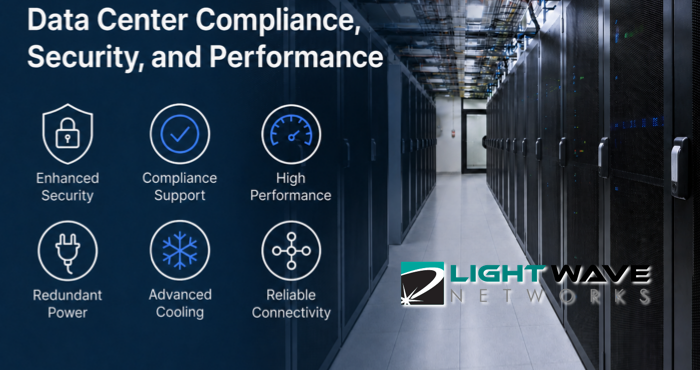
A colocation facility can support those efforts through controlled physical access, secure cabinets, monitored environments, redundant infrastructure, and documented operating practices. Organizations should confirm which standards a facility supports and how responsibilities are divided between the provider and customer.
Colocation also gives customers direct control over their hardware, storage, networking, and system architecture. This flexibility is valuable when standardized hosting or cloud plans cannot meet a workload’s configuration, latency, power, cooling, or capacity requirements.
Financial Services
Banks, payment processors, investment firms, insurance companies, and financial technology providers depend on systems that process sensitive information and support time-sensitive transactions.
Colocation for financial services firms can provide a controlled environment for transaction platforms, customer records, risk-management systems, and other critical equipment. Redundant connectivity and power infrastructure can also help organizations reduce the operational risks associated with an outage.
Financial organizations may need to address PCI DSS requirements, audit obligations, cybersecurity controls, and record-retention policies. A provider’s facility controls and documentation can support those programs while the financial institution remains responsible for its own systems, applications, and governance.
Healthcare and Health Technology
Healthcare providers, laboratories, medical software companies, and health technology platforms may process protected health information across clinical, billing, imaging, and administrative systems.
Colocation can give these organizations greater control over where their hardware is located and who can physically access it. A professionally managed facility can also offer more dependable power, cooling, and environmental monitoring than equipment housed inside a medical office or administrative building.
Healthcare organizations should confirm whether a provider can support their HIPAA-related requirements, including any necessary agreements, documentation, security measures, and operational procedures.
E-Commerce and Payment Platforms
Online retailers and payment platforms need infrastructure that can remain available during seasonal demand, promotions, product launches, and sudden traffic increases.
Colocation lets these businesses select server, storage, and network configurations based on transaction volume and application requirements. They can also design redundant systems that reduce dependence on a single server, connection, or piece of equipment.
Businesses that store, process, or transmit payment-card information must consider how their infrastructure supports PCI DSS requirements. The facility can help protect the physical environment, while the business remains responsible for areas such as application security, access controls, and payment-data handling.
Software, SaaS, and Digital Platforms
Software companies and SaaS providers need reliable infrastructure for customer applications, databases, development environments, and production workloads.
Colocation can benefit established platforms with predictable demand, specialized configurations, or hybrid infrastructure strategies. These companies can retain control of core systems while connecting colocated equipment with cloud resources, dedicated servers, or other environments.
Carrier options, network capacity, scalable cabinet space, and low-latency connectivity may be especially important for platforms serving customers across multiple markets.
Artificial Intelligence and High-Performance Computing
AI training, analytics, engineering simulations, scientific computing, and other high-performance workloads can require dense deployments of GPUs and specialized servers.
These systems often use more power and generate more heat than conventional business equipment. Colocation for high-performance computing therefore requires careful planning around power density, cooling, network capacity, hardware dimensions, and future expansion.
GPU colocation and AI server colocation also allow organizations to select and own the equipment used for their workloads. This can provide more control over hardware availability, data placement, workload scheduling, and long-term infrastructure costs than relying entirely on rented cloud capacity.
Manufacturing, Engineering, and Industrial Technology
Manufacturers and engineering organizations increasingly depend on automation systems, connected equipment, design applications, digital twins, analytics, and operational data.
Some of these systems need consistent processing and dependable connectivity between production facilities, remote users, and centralized infrastructure. Colocation can provide a stable location for proprietary servers, storage systems, and network equipment without requiring the organization to build its own data center.
It can also support equipment or configurations that do not fit neatly within standard cloud or hosting services.
Legal and Professional Services
Law firms, accounting practices, consulting companies, and other professional-services organizations manage confidential client records, financial information, intellectual property, and litigation materials.
These businesses may choose colocation when they want to retain control over critical systems while improving physical security and infrastructure reliability. Moving equipment out of a typical office can reduce exposure to inadequate cooling, localized power failures, theft, and accidental damage.
The organization should still evaluate whether it has the technical resources needed to manage its hardware or whether it needs additional monitoring, maintenance, or remote support.
Choosing Colocation for Your Industry
The right colocation environment depends on the workload, compliance obligations, technical capabilities, and growth plans of the organization using it.
Before selecting a provider, evaluate its physical controls, power and cooling capacity, connectivity, redundancy, certifications, support options, and ability to accommodate future equipment. Organizations with regulated data or specialized hardware should also document which responsibilities belong to the facility provider and which remain with their internal teams.
Lightwave Networks works with organizations across regulated and data-intensive industries. If your organization is planning for stricter compliance requirements, higher-performance workloads, or long-term infrastructure growth, a consultative infrastructure assessment can help identify the right colocation environment.
We provide colocation services for organizations that need secure facilities, customizable infrastructure, and support for regulated or high-performance environments. Connect with one of our engineers to discuss your data center compliance responsibilities, workload requirements, and infrastructure goals.