
Tag Archives: liquid cooling
Understanding Liquid Cooling, Power, and Redundancy in Colocation Facilities
Modern infrastructure demands have shifted fast. High-density compute, AI training clusters, and advanced cooling strategies like liquid coolingare no longer edge cases. They are becoming baseline requirements. At Lightwave Networks, this shift is shaping how colocation facilities are designed to support GPU colocation, AI server colocation, and sustained high-performance workloads.
Understanding how these systems are designed, and more importantly, how they work together, is what separates a facility that simply houses equipment from one that is built to support modern, high-density infrastructure.
Why Power Infrastructure Is the First Constraint
Power availability is often the limiting factor in high-density deployments. A traditional rack might operate comfortably at lower kilowatt ranges. However, AI and GPU clusters can push far beyond that, especially in GPU hosting environments where multiple accelerators are stacked within a single footprint.
A facility designed for modern workloads must go beyond simple capacity. It needs structured power redundancy that can maintain uptime during failure events without introducing instability during load transitions.
A redundant power supply design typically follows models such as N+1 or 2N. In practice, that means there is at least one independent backup path for power delivery, or in higher-tier environments, a fully mirrored system that can carry the entire load if one path fails.
The difference becomes critical during real-world scenarios. A single power path failure in a non-redundant system can result in immediate downtime. In a properly designed data center power redundancy model, the failover is handled without interruption, assuming the load is balanced correctly and the infrastructure is maintained.
For organizations running latency-sensitive or compute-intensive workloads, this is not just a reliability feature. It is a performance safeguard.
Cooling Is No Longer Secondary to Power
Cooling used to be treated as a supporting system. That is no longer the case. As rack densities increase, cooling capacity and efficiency become just as important as power delivery.
Air cooling still plays a role, but it has limits. As heat output rises, air-based systems can struggle to maintain consistent temperatures across densely packed hardware. This is where liquid cooling becomes increasingly important for high-density colocation facilities.
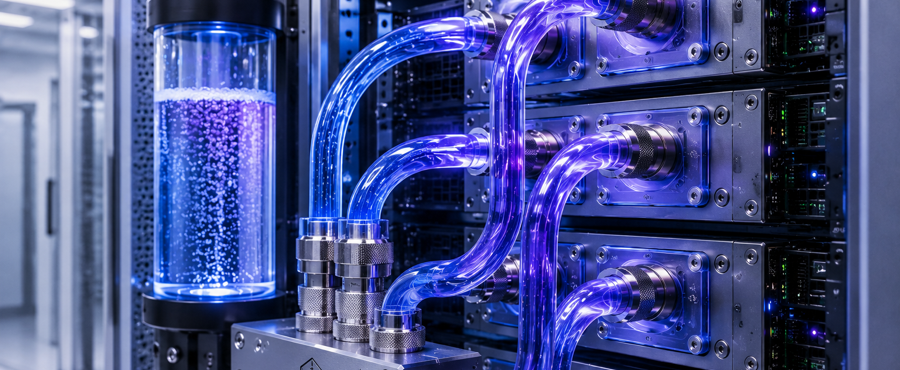
Liquid cooling systems are designed to remove heat more efficiently by transferring it directly from high-output components. In liquid-cooled GPU environments, this can dramatically improve thermal stability, especially during sustained workloads like AI training or inference at scale.
However, not every environment requires full liquid cooling, and not every GPU setup benefits equally. Hybrid approaches are common, where air cooling handles baseline loads while liquid systems are deployed for high-density zones.
The key is not the presence of liquid cooling alone, but how it integrates with a broader cooling redundancy strategy.
What Cooling Redundancy Actually Looks Like
Cooling redundancy is often misunderstood as simply having extra equipment. In reality, it is about maintaining environmental stability during failure conditions.
A redundant cooling system might include additional chillers, backup pumps, or independent cooling loops that can take over if a primary system fails. The goal is to prevent temperature spikes that could trigger hardware throttling or shutdowns.
In high-density environments, even a short disruption in cooling can have cascading effects. GPUs and CPUs may reduce performance to protect themselves, which impacts workload completion times and overall system efficiency.
This is where system redundancy and system design intersect. A well-designed colocation facility anticipates these failure points and ensures that cooling transitions happen smoothly, without introducing thermal shock or uneven distribution.
Power and Cooling Must Be Designed Together
One of the most overlooked aspects of colocation design is the relationship between power delivery and cooling systems. These systems are deeply interconnected.
Higher power density increases heat output. Increased heat requires more aggressive cooling. More aggressive cooling demands additional power. Without careful planning, this creates a feedback loop that can strain both systems.
Colocation facilities built for modern workloads are designed with this relationship in mind. Power distribution units, cooling capacity, and airflow or liquid pathways are coordinated to support consistent performance across varying load conditions.
This becomes especially important in environments supporting GPU server colocation and AI workloads, where both electrical and thermal loads can fluctuate rapidly based on demand.
The Role of Redundant Systems in Uptime and Performance
Redundancy is often framed as a safeguard against downtime. That is true, but it also plays a role in maintaining consistent performance.
A redundant system is not just a backup. It is part of an active architecture that allows maintenance, load balancing, and failure handling without disrupting operations.
For example, a redundant power configuration allows one system to be serviced while the other continues to carry the load. The same applies to cooling systems that can rotate or share load across multiple units.
This flexibility becomes essential in environments where uptime requirements are strict, and workloads cannot be paused without consequence.
Liquid Cooling and the Future of High-Density Infrastructure
As AI workloads continue to scale, liquid cooling is becoming more relevant. It enables higher rack densities, improves thermal efficiency, and supports sustained performance under heavy computational loads.
That said, it introduces additional design considerations. Fluid management, leak detection, and system integration all become part of the operational model.
Not every facility is built to support this level of complexity. Those that typically position liquid cooling as part of a broader infrastructure strategy, not a standalone feature.
Bringing It All Together
Power, cooling, and redundancy are not independent systems. They form a single operational framework that determines whether a colocation environment can support modern infrastructure demands.
Colocation facilities that are designed to support high-density and AI-ready workloads focus on balanced power delivery, efficient and scalable cooling, and clearly defined redundancy layers that maintain both uptime and performance during real-world conditions.
When these elements are aligned, the result is an environment that is not just reliable but capable of supporting the next generation of computing. We build colocation environments designed to support these demands, including infrastructure optimized for AI server hosting, GPU hosting, and high-density deployments.
To evaluate how power delivery, cooling methods, and redundancy layers align with your infrastructure requirements, explore our colocation capabilities. Connect with a Lightwave Networks engineer today to review options built for high-performance workloads.
FAQ: Power, Cooling, and Redundancy in Colocation
What is a redundant system in a data center?
A redundant system in a data center is a backup or parallel component designed to maintain operation if a primary system fails. In colocation facilities, redundancy is commonly applied to power and cooling systems to support uptime and stability.
What is the advantage of having a redundant power supply?
The advantage of having a redundant power supply is that it allows infrastructure to continue operating during a power failure or maintenance event. This reduces downtime risk and supports consistent performance for high-density workloads.
Can you liquid cool any GPU?
Not all GPUs are designed for liquid cooling. Compatibility depends on hardware design, cooling infrastructure, and deployment requirements. Many high-density AI environments use liquid cooling to manage sustained thermal loads.
Why is cooling redundancy important in colocation facilities?
Cooling redundancy is important in colocation facilities because it helps maintain stable temperatures if a primary cooling system fails. This prevents thermal spikes that can reduce performance or trigger system shutdowns.